
What to expect from a custom kitting service
We recently assembled conference kits, a branded bag, bottle, and journal apiece, timed to land at the venue just before the doors opened. Before that, it was onboarding packages for a company with new hires across six provinces. The details change, but the work is the same: sourcing products, assembling them into kits, and shipping the finished packages where they need to go. This post walks through how that process actually works and what to ask before choosing a kitting partner.
What is custom kitting?
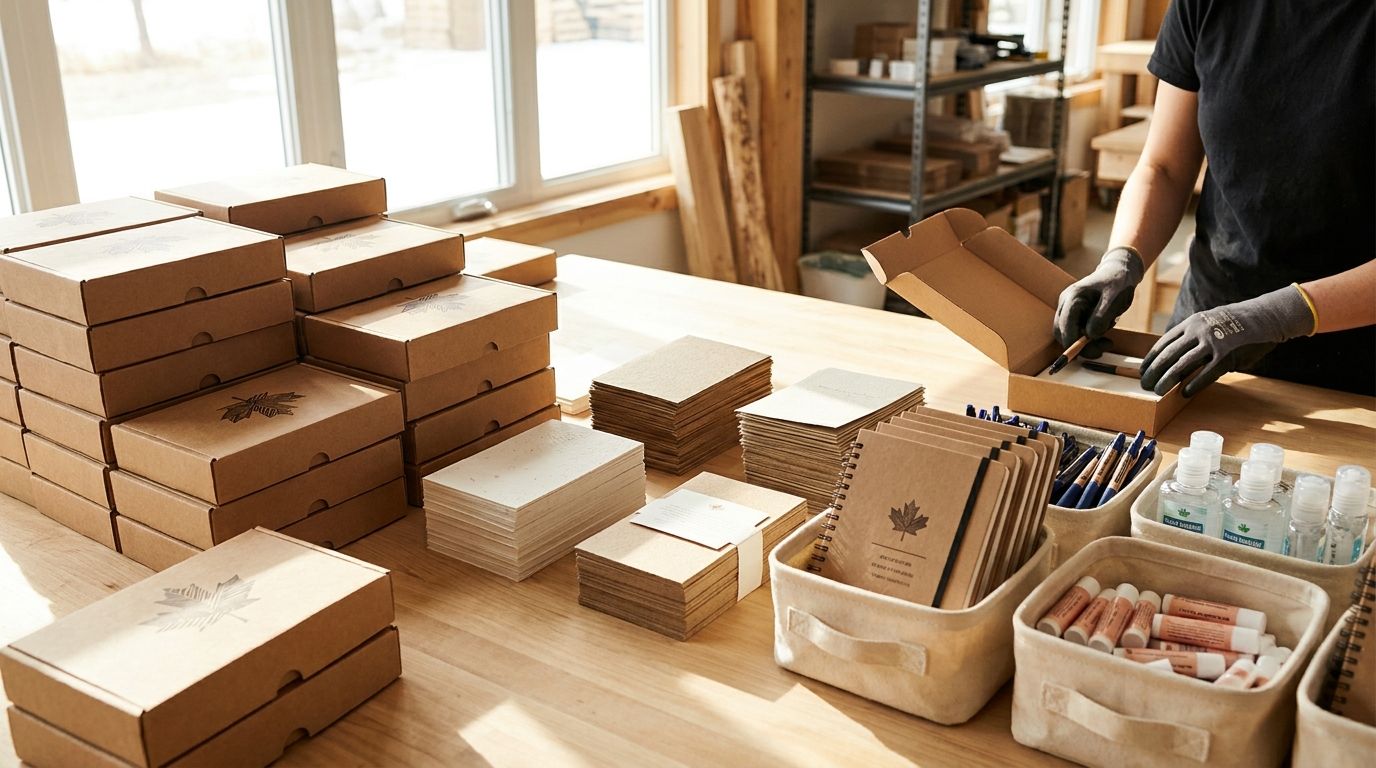
Custom kitting is the process of assembling multiple items from different sources into a single, finished package. A typical project might involve five or six different suppliers, each shipping their component to your kitting partner's facility. From there, every item gets inspected, assembled by hand against a checklist, packed with branded materials, and shipped to individual addresses or bulk locations across the country.
The result is a finished product that looks and feels intentional, like it was designed as one thing, even though the items inside may have come from five or six different vendors.
The types of kits we see most often: employee onboarding packages with branded apparel and tech accessories, event swag bags for conferences, wellness kits for community outreach, milestone reward boxes for service anniversaries, and school supply bundles sometimes combined with spirit wear.
The common thread is coordination. Every kit has multiple components, a hard deadline, a recipient list, and a quality standard that has to hold up across every single package, not just the first fifty.
How the kitting process works
The process is the same for 50 kits as it is for 2,000. Scale changes the logistics, but not the steps.
1. Scoping and sourcing
Everything starts with a conversation about what goes in the kit, who receives it, when it needs to arrive, and what your budget looks like. For larger programs, we talk through phased delivery, address collection timelines, and contingency plans. Once the kit contents are defined, we source every item. Some may be standard promotional products from our supplier network. Others might be custom, like a printed cookbook, a branded insert card, or a specialty food item. We provide samples for approval before committing to production quantities, and if something exceeds budget or is unavailable, we suggest alternatives that maintain the look and feel you are going for.
As items arrive at our facility in Kemptville, Ontario, each shipment is inspected and counted against the purchase order. Damaged or incorrect items get flagged immediately so replacements can be ordered without delaying the project. We do not start assembly until every component is received, inspected, and accounted for.
2. Assembly and quality control
Each kit is assembled by hand against a detailed checklist: every item present, correctly oriented, placed according to the agreed layout. For kits with personalized elements, like a name card or size-specific apparel, we match each component to the correct recipient during assembly. After that, kits go through quality control: spot checks on random packages, weight verification to catch missing items, and visual inspection of packaging integrity. Anything that does not pass gets pulled, corrected, and re-checked. We would rather catch a problem here than have a recipient open an incomplete package.
3. Packaging
This is where a lot of kitting projects fall flat. If someone opens a beautiful branded gift and it is wrapped in plain brown paper with crumpled newsprint as padding, the effect is lost. Depending on the project, we use branded boxes, custom tissue paper, printed inserts, thank-you cards, or branded packing tape. For recognition and gift kits especially, the unboxing experience is part of the deliverable.
4. Shipping and reporting
Assembling the kits is one thing. Getting all of them to the right doors is another problem entirely. We handle individual address shipping across Canada, bulk delivery to a single location, and multi-location splits (say, a hundred to head office and the rest to regional teams). For programs with rural or remote addresses, we plan carrier selection and timelines early to avoid delivery surprises. After shipment, you get confirmation of delivery, tracking numbers, and a summary of any exceptions. If a package could not be delivered due to an address issue, we flag it and work with you to resolve it.
What to look for in a kitting partner
Plenty of promotional products companies will say they offer kitting. Fewer actually have the warehouse space, assembly workflow, and shipping infrastructure to deliver on it. Before you commit, ask these questions:
Find out whether they can source custom items: printed booklets, specialty foods, things outside a standard promo catalogue. If they can only order from their existing suppliers, complex kits will be a problem. Ask about printed materials too, since many kits include inserts, instruction cards, or custom publications that someone needs to produce or coordinate.
Get specific about quality control. "We check everything" is not a process. You want to hear about checklists, weight verification, spot checks, and what happens when something is wrong. Ask whether they can ship to individual addresses across Canada, including rural communities, and whether they manage the timeline proactively or just react when things go sideways. If your project involves 1,000 or more kits, ask about their experience at that scale: staging space, assembly workflow, carrier coordination, and phased shipping all get harder with volume.
Real-world example: conference kits on the venue's clock
For a recent conference, every attendee kit held a branded bag, a bottle, a journal, and a set of promotional items, all sourced and decorated by us, then pre-assembled in our facility so each bag was identical and ready to hand out.
The difficulty was not the assembly; it was the calendar. Conference centres are not warehouses, so the kits could not arrive weeks early and sit on a loading dock. Delivery had to land inside the venue's receiving window, which means the sourcing, decoration, and assembly all finish on a schedule built backward from a date that cannot move.
That coordination, staging space, an assembly workflow, and carrier timing matched to a venue's receiving hours, is the part most promo suppliers are not set up to do. The full story is in our conference swag kits case study.
Kitting for different industries
We have done kitting projects for school boards, HR departments, event organizers, healthcare outreach programs, and government agencies. The contents change; the process does not.
For education clients, that usually means school supply kits bundled by grade level, spirit wear packages for incoming students, teacher appreciation gifts. School boards usually need identical kits across multiple schools, which makes inventory planning and multi-location shipping the hard parts.
For HR departments, the typical projects are onboarding kits that arrive before a new hire's first day, milestone reward boxes for service anniversaries, and holiday gift packages for remote teams. These programs often require personalization (size-specific apparel, name-printed cards), which adds complexity to the assembly step. Event kitting is similar in scope but runs on tighter timelines: attendee swag bags, speaker gifts, sponsor kits, usually shipped in bulk to a single venue.
Healthcare and government kitting serves different needs. Wellness kits for public health outreach, mental health resource packages, program supplies for community organizations. These projects often serve diverse populations and may require bilingual materials, culturally appropriate items, and accessibility considerations. Public sector programs procured through OECM agreements or other cooperative purchasing vehicles tend to be larger, require detailed reporting, and must meet specific procurement compliance standards.
Getting started with your kitting project
If you have a kitting project in mind, even a rough idea, it helps to loop us in early. We can flag sourcing lead times or budget issues before they become problems. For a deeper look at how our logistics operation handles nationwide delivery, read our post on how we manage nationwide fulfillment for branded merchandise. When you are ready to talk specifics, reach out to our team and we will walk you through what the process looks like for your project.