
How to choose a school spirit wear program
Most schools that come to us have already tried spirit wear in some form. Maybe it was paper order forms sorted by volunteers in the gym, or a vendor that disappeared after one season. The bar is not high, but the difference between a program that fizzles and one that parents actually use comes down to a few specific things: how much work it creates for your staff, what the products look like after ten washes, and whether families can order without jumping through hoops.
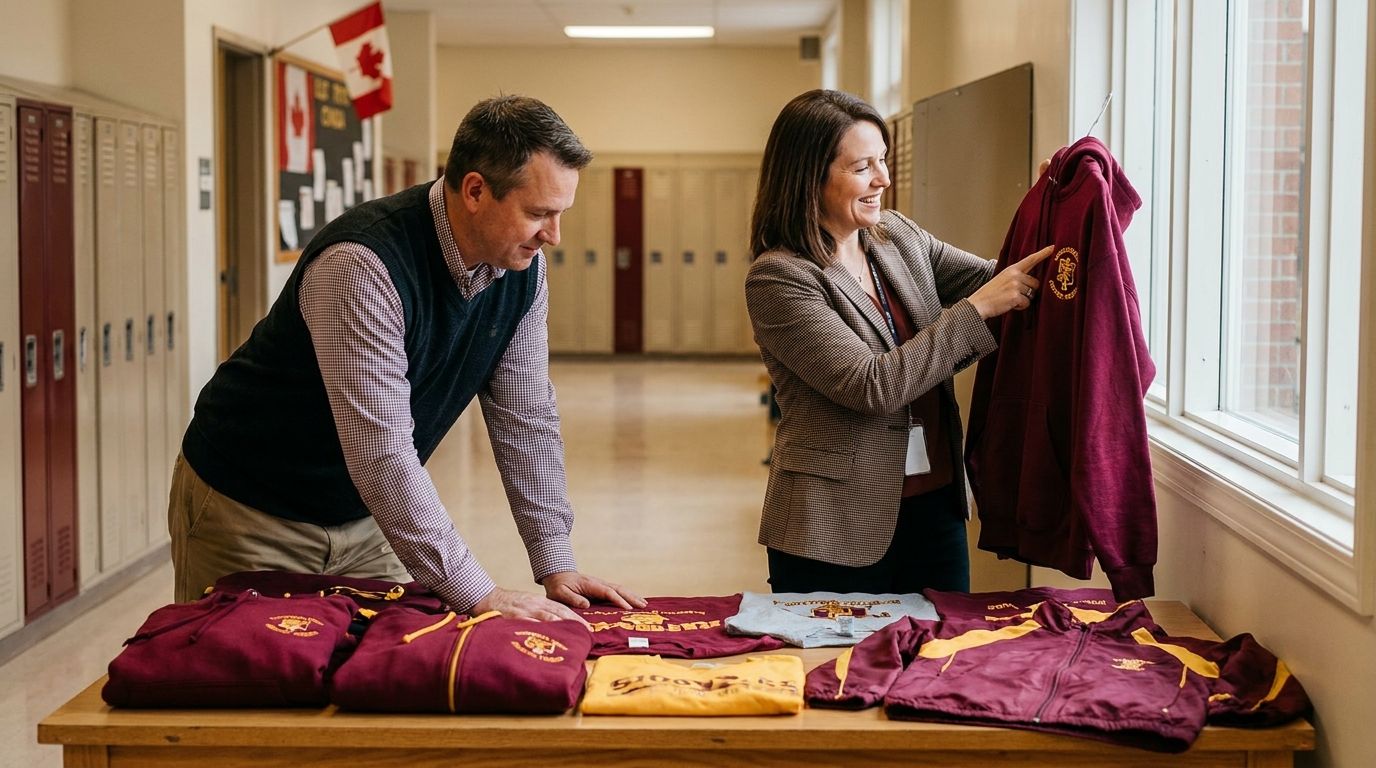
This guide covers what to look for in a vendor, what questions to ask up front, and a few decisions that matter more than most schools realize when they start shopping around.
What makes a great school spirit wear program
At one end, vendors drop-ship generic products with a logo heat-pressed on. At the other, a vendor runs your store, handles the orders, and gives you back a cut of the sales. Here is how to tell which one you are talking to.
Ask exactly how setup is scoped and what it includes; the cost structure should be clear before anything is built. The strongest programs fund themselves primarily through product margins rather than leaning on your school budget.
Parents should be able to browse, pick sizes, and pay from home. If your current program still relies on paper order forms and cash envelopes sorted by volunteers in the gym, a hosted online store eliminates all of that. Families shop on their own time, and nobody has to chase down missing cheques.
Product quality matters more than price per unit. A hoodie that pills after three washes or a logo that cracks in the dryer reflects poorly on your school and frustrates parents. Your spirit wear should still look sharp in June even if it was purchased in September. Ask for samples before you commit. And check the size range early: a program that only offers youth S through adult L will leave some families out. You want youth extra-small through extra-large and adult sizes that go well beyond large.
Most schools do not have a polished, print-ready logo file sitting in a shared drive. A good vendor will clean up low-resolution logos, prep artwork for different decoration methods, and help you develop designs that actually look good on fabric. That kind of design support should be included, not billed as an add-on.
The real test of a spirit wear program is how little work it creates for your office staff. You share a link with families. The vendor handles orders, production, shipping, returns, and customer service. If your staff are sorting orders or fielding sizing questions, the vendor has handed the job back to you.
Questions to ask before choosing a vendor
These are the questions we would ask if we were in your shoes. The answers will tell you quickly if a vendor is set up to actually run a program for your school, or if you will end up doing most of the work yourself.
Start with the store itself. Who builds and hosts it? The vendor should handle that entirely, with no technical skills or web hosting required from your school. And the cost structure should be clear up front: no hidden fees and no surprises for hosting or ongoing management.
Then dig into the products. Ask to see samples. Feel the fabric, check the stitching, look at how logos are applied. Ask about size ranges specifically: a program that tops out at adult large is leaving families behind. You also want to know turnaround times, both for the initial store launch and for ongoing orders after that.
A few other things worth asking: does the vendor offer a fundraising percentage back to the school, and how is that calculated? Can the store run year-round, or only in seasonal windows? Who handles returns and exchanges when a parent needs a different size? Can the product catalog be updated to add seasonal items like graduation hoodies or fall toques, and is that included or billed extra?
Why local matters for schools in Ottawa and Ontario
You can order school spirit wear from a vendor anywhere in the country, and some national suppliers do a fine job. But there are real, practical advantages to working with a local partner, especially for schools in Ottawa, eastern Ontario, and the surrounding region.
When your vendor is nearby, timelines shrink. Need last-minute spirit day shirts or graduation hoodies that got approved late? A local vendor can often turn those around in days, not weeks. We are based in Kemptville, Ontario, just south of Ottawa, so many of our school clients get their orders faster than they would from a vendor shipping cross-country.
There is also a knowledge advantage. Ontario school boards, both public and Catholic, English and French, have their own policies around branding, procurement, and vendor approval. A local vendor who has already worked with boards in your region understands these requirements and can navigate them without slowing down your timeline. For boards that purchase through the Ontario Education Collaborative Marketplace, working with an OECM-approved supplier means your purchasing policies are already satisfied and you can skip additional vendor qualification steps.
Sometimes it just helps to sit down together. Look at fabric samples, review logo placements, talk through program options face to face. A local partner can meet you at your school and walk your team through everything in person. That is hard to replicate with a vendor three provinces away.
And in the Ottawa region especially, bilingual capability matters. Many schools operate in French or offer French immersion programs. A local vendor experienced in bilingual execution can build your store, product descriptions, and promotional materials in both English and French from the start, rather than treating it as an afterthought.
What to look for in product quality and decoration
The decoration method used on your spirit wear directly affects how the products look, feel, and hold up over time. Not all methods are suited for every product, and a knowledgeable vendor will recommend the right approach based on your design, the garment, and how the item will be used.
For school crests, mascots, and simple logos, embroidery is hard to beat. Stitched designs hold up through hundreds of wash cycles and look premium on hoodies, polos, and toques. Screen printing is the better choice for bold, colourful designs on t-shirts and sweatshirts, especially in larger runs where per-unit cost matters.
If your school wants full-colour athletic jerseys or all-over prints, sublimation bonds the ink directly into the fabric so it never cracks or peels. And for complex logos with gradients or photographic detail, direct-to-film (DTF) heat transfers give you precision that other methods cannot match, even on small orders. A good vendor will recommend the right method for each product rather than defaulting to whatever is easiest for them.
Beyond decoration, pay attention to the garments themselves. Active kids put their clothes through serious wear. Look for ring-spun cotton or cotton-polyester blends that resist pilling, maintain their shape after washing, and feel comfortable against skin. Paying twelve dollars for a shirt rather than eight is usually the cheaper choice by December.
Making it easy for your school community
Great products do not sell themselves if the ordering process is confusing. We have seen schools with beautiful spirit wear and terrible participation, simply because parents could not figure out how to place an order. The store experience matters as much as what is in it.
Parents are used to shopping online, and your spirit wear store should feel just as straightforward: clear product photos, accurate sizing guides, easy checkout, and order confirmation emails. If parents have to call someone to place an order or figure out a clunky system, participation drops. Payment options matter too. Credit card should be standard, but families appreciate having debit and digital wallet options available.
Parents also want to know when their child's hoodie will arrive. A good vendor sends order confirmations, production updates, and shipping notifications with tracking. If a parent has to wonder whether their order went through, the experience falls short.
One decision worth discussing early is whether to run the store year-round or in seasonal windows. A year-round store keeps orders flowing steadily and lets families replace a lost hoodie in February or grab a birthday gift in April. Seasonal windows (September, December, spring) create urgency and can generate bigger order bursts around key dates. Many schools start with seasonal windows and transition to year-round once the program is established.
Choosing the right partner for your school
Your spirit wear vendor will be the one parents contact when a size is wrong, the one your office staff rely on to keep the store running, and the face behind every product your students wear. That relationship matters more than pricing spreadsheets.
If you are evaluating vendors, the short list of non-negotiables: a clear, upfront cost structure, a real online store (not a PDF order form), professional decoration, inclusive sizing, and optional fundraising. Ask for references from other schools they work with, and pay attention to how responsive they are during the evaluation. That is a reliable preview of what the relationship will look like once you are a client.
For a detailed walkthrough of how a hosted school spirit wear store actually operates day-to-day, read our companion post: How school spirit wear stores work. It covers the full process so you know exactly what to expect once you launch.
If you are ready to explore what a custom school store could look like for your school, we would love to hear from you. We work with schools across Ottawa, Ontario, and Canada, and there is no commitment or cost to start the conversation.