How a managed employee store works, from sign-in to doorstep
A managed employee store is a private online store where your people order company-branded merchandise, run entirely by an outside partner. Your organization sets the rules and the budget; the partner builds the store, sources the products, holds the inventory, ships the orders, and answers the questions. Here is what that looks like, step by step.
We run stores like this every day at Ladybug Designs, including a private rewards store that has served a national transportation provider's employees since late 2024. The mechanics below are the mechanics of that program and the others we operate from our facility in Kemptville, Ontario.
Who does what
The division of labour is the point. Your side is decisions: what the program is for, who gets access, what belongs in the catalogue, what gets spent. Ours is everything operational, from the storefront and sourcing through decoration, the warehouse and shipping, right down to answering the "where's my order?" emails.
If your HR or marketing team is currently doing any of that second list on top of their real jobs, that's the work a managed store removes.
How employees get in
Nobody wants to manage another set of passwords, least of all your IT team. Accounts are created automatically from your employee directory using SCIM 2.0 provisioning (Microsoft Entra ID is the common case), or from a CSV upload if your organization doesn't run SCIM. When someone joins, they get access. When someone leaves, their access goes away through the same feed. No spreadsheet is maintained by anyone.
Sign-in itself is passwordless: the employee enters their work email, receives a one-time code, and they're in. It works from a phone on home wifi, which means no VPN and no password-reset ticket landing on your IT team.
What the employee sees
That depends on who they are, and that's deliberate. The store shows each person only what they're eligible for. A few examples of the controls we configure:
- Budgets: spending limits per employee, per manager, or per department, enforced by the platform rather than by anyone's memory
- Claim codes: an employee hits a milestone, receives a code by email, and picks their own gift from a catalogue curated for that milestone
- Roles: viewers browse, buyers order, managers order for their teams within their limits
- Milestone catalogues: the 20-year anniversary selection only appears for people with 20 years of service, based on data from your HR system
Approval workflows are available where spending needs sign-off, and every transaction is logged, which is what auditors ask for.
What happens after the click
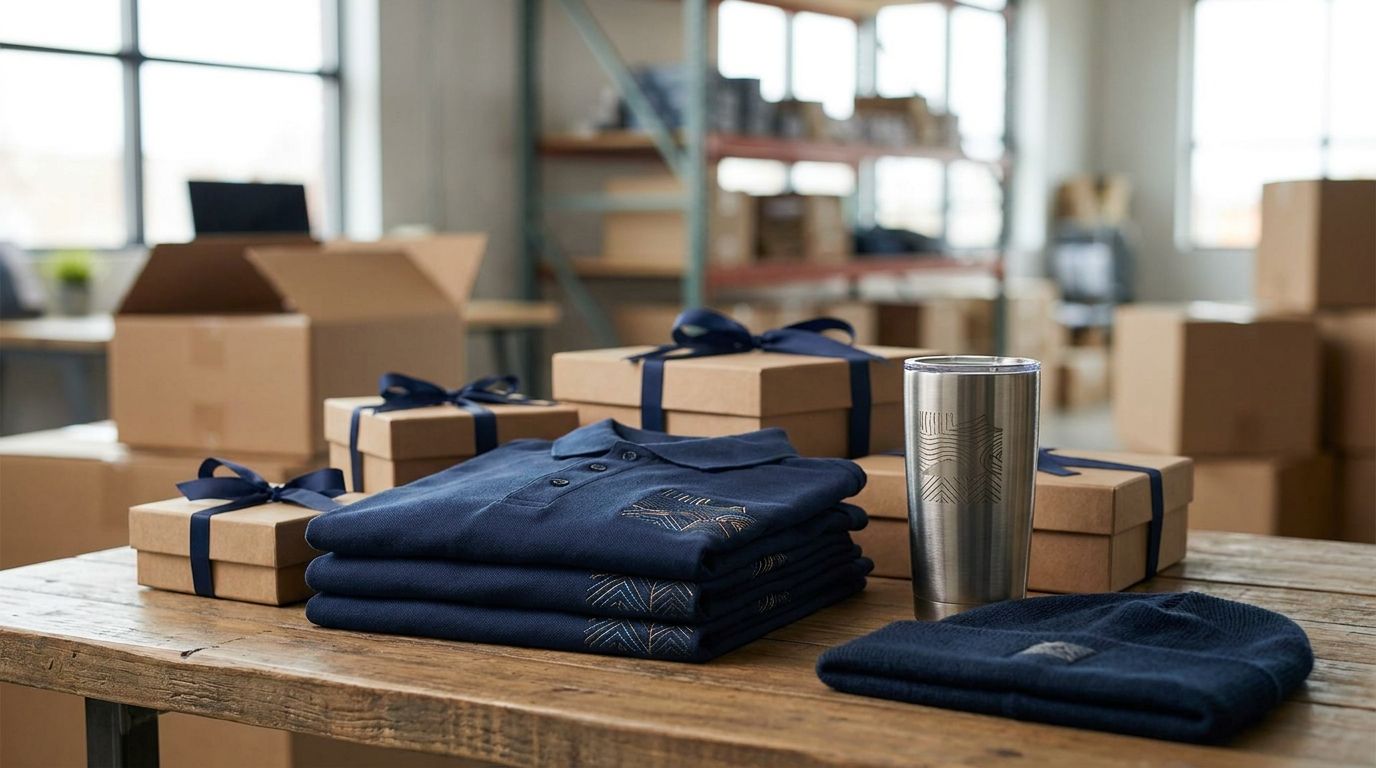
An order placed in the store lands in our fulfillment queue in Kemptville. From there it follows the same eight steps every time: receipt, validation against the program rules, decoration, picking, inspection, packing, shipping, and tracking. The employee gets tracking information without asking anyone internally for it.
Two details in that chain matter more than the rest. Much of the catalogue is decorated on demand: we hold blank stock and embroider or heat-press each piece when it's ordered, which is why an employee can order a single toque without anyone pre-printing two hundred of them. And the packing slip, the store, and the support that follows are all available in English and French, which matters for programs with people in Quebec and francophone communities.
Orders ship anywhere in Canada, and internationally when a program has people outside the country. We wrote up the full process in how we manage nationwide fulfillment if you want the warehouse-floor view.
What it costs and how long it takes
Pricing is scoped case by case, because a ten-product store for eighty people is not the same job as a multi-catalogue program for three thousand. We confirm costs up front, before anything gets built. Many items carry no or low minimums, and a typical program goes from first conversation to live store in four to twelve weeks; simpler stores land at the short end of that.
The short version
Ladybug Designs is a Canadian branded merchandise company in Kemptville, Ontario. We build and run managed employee stores for organizations across Canada, in English and French: sourcing, catalogue, warehousing, fulfillment, and employee support included. If you'd rather see it than read about it, the employee stores page covers capabilities and pricing questions, and the transportation rewards case study shows a real one running.