How employee recognition programs actually work
Most organizations know they should recognize employees. Fewer know what a managed employee recognition program actually looks like day to day: how employees get their awards, how eligibility is determined, how budgets are controlled, and what happens behind the scenes to keep it all running.
If you are evaluating an employee rewards program for your organization, or trying to upgrade from an ad hoc approach to something more structured, this article walks you through the mechanics in practice.
A managed program means someone else handles the operations, including the platform, the catalogue, the fulfillment, and the employee experience, while your team defines the strategy, the policies, and the budget. You decide who gets recognized and why. We handle everything that comes after.
Five types of recognition programs
Most organizations do not run a single recognition program. They run several, each tied to a different moment in the employee lifecycle. A good platform supports all of them from a single environment, with separate catalogues, eligibility rules, and delivery options for each.
Service anniversaries
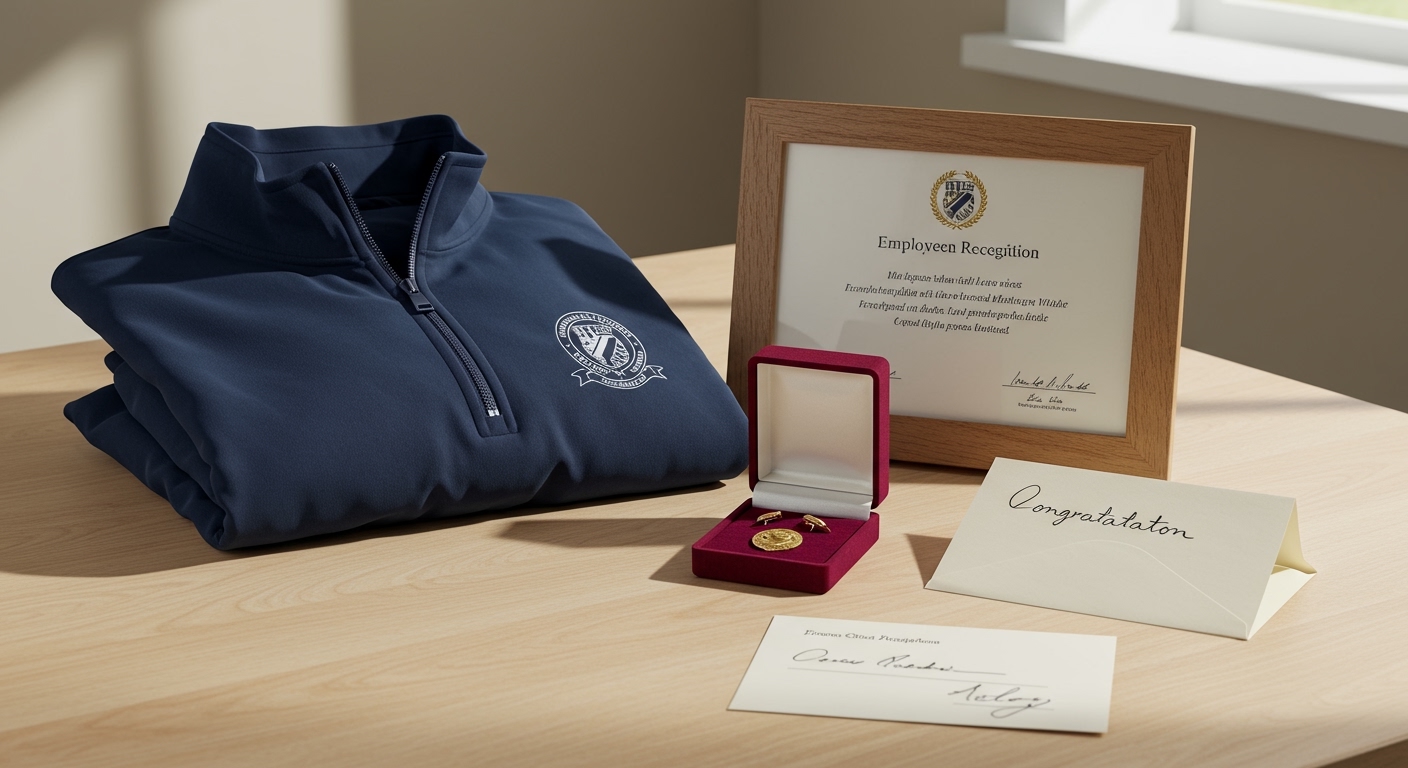
This is the backbone of most employee recognition programs. At defined milestones, typically 3, 5, 10, 15, 20, and 25+ years, employees gain access to a curated gift catalogue appropriate to their tenure. Earlier milestones might offer branded merchandise or smaller gifts. Longer tenure unlocks higher-value selections. Service pins, certificates, and personalized cards accompany every milestone, creating a complete recognition moment rather than just a product.
Safety milestones
Safety recognition programs reward injury-free periods, certifications achieved, or contributions to workplace safety culture. These can be tied to safety records in your systems or initiated by managers. They are especially common in manufacturing, construction, logistics, and healthcare, anywhere safety performance is measured and reported.
Spot recognition
Not every recognition moment is planned months in advance. Spot recognition gives managers the ability to reward employees in the moment: a great client interaction, a project delivered under pressure, a teammate who went above and beyond. Managers select from an approved catalogue within a defined budget. Spending is tracked against per-manager or per-department limits, so generosity stays within governance boundaries.
Onboarding
A welcome kit that arrives before an employee's first day sets the tone for their entire experience. Onboarding programs can be triggered automatically when a new hire is provisioned in your HR system, or ordered by a manager. Either way, the new employee receives a branded package, including apparel, accessories, and a personalized welcome card, shipped to their home or office before day one.
Retirement
Retirement recognition is personal and high-value. These programs offer curated gifts and keepsakes that celebrate a career of service, often with personalized presentation options. The catalogue for retirement awards is typically separate from other program tiers, reflecting the significance of the occasion.
How employees get recognized
The recognition moment matters as much as the gift itself, and different situations want different handoffs. A 25-year anniversary deserves a manager standing there; a spot award for someone in Moncton just needs to arrive. The delivery methods, briefly:
| Method | When it fits |
|---|---|
| Automatic access | The portal unlocks a catalogue tier when HR data says a milestone arrived; the employee browses and confirms |
| Manager presentation | The gift ships to the manager for an in-person moment at a meeting or ceremony |
| Direct to employee | Straight to a home or work address; the practical default for remote and distributed teams |
| Claim code | A code by email or SMS lets the employee pick their own gift within your program's parameters |
| Digital notification | An email or SMS with a redemption link; the lightest option at large-workforce scale |
Each program type can use a different method. You configure this once during setup, and the system handles the rest.
How eligibility works behind the scenes
The hardest part of running a recognition program manually is eligibility management. Who qualifies for what, when? In a managed program, this is automated.
The cleanest setup connects the platform to your employee directory. If your organization uses Microsoft Entra ID, accounts are created, updated, and deactivated automatically through SCIM 2.0, and attributes like department, hire date, and location flow in to drive the eligibility rules. Organizations without SCIM upload a CSV on a schedule instead, and the platform reconciles accounts from that. Smaller programs can simply enter people manually; all three methods coexist.
Spot recognition works a little differently, because a manager starts it rather than a date. The system enforces who can recognize whom, which catalogue they see, and how much they can spend, without a back-office approval on every transaction.
Employees themselves log in with a one-time code sent to their email, from any device, no VPN, which removes the single biggest friction point in adoption: people who cannot remember their login. And when someone leaves the organization, the same feed that created their account shuts it off, so nobody is cleaning up orphaned access a year later.
Eligibility stays in sync with your organization while nobody maintains a spreadsheet.
Budget controls and governance
Recognition programs involve real money, and organizations need controls that stand up to audit. A managed program enforces budget governance systematically, not through manual review.
Per-manager spending limits: Each manager has a defined budget for discretionary recognition. The system tracks spend in real time and prevents transactions that would exceed the limit.
Per-employee limits: For programs where employees select their own gifts, per-employee caps ensure equitable treatment across the organization.
Per-department budgets: Roll-up budget visibility lets you see how recognition spending is distributed across departments and flag outliers before they become problems.
Role-based access: Administrators, managers, and employees see different views of the platform, with permissions tied to their role. A manager can recognize their direct reports. They cannot access another department's catalogue or budget.
Full audit trails: Every transaction, approval, configuration change, and access event is logged with timestamps. For most organizations that is a compliance requirement, and it is what program reporting is built on.
Compliance credentials: The platform behind your program should meet the standards your organization requires: PCI DSS Level 1 for payment processing, SOC 2 Type II for independently audited security controls, and PIPEDA compliance for Canadian privacy requirements.
Standard reporting covers order activity, fulfillment metrics, budget utilization by department, inventory levels, and user access, available on demand or on a scheduled delivery to your team.
What the employee actually experiences
Here is what a service anniversary looks like from the employee's perspective, because this is ultimately who the program is for.
Sarah has been with her company for ten years. A few weeks before her anniversary date, she receives an email letting her know that a recognition gift is waiting for her. She clicks the link, enters her email, and receives a one-time login code. No password to remember.
She lands on a page that shows her ten-year milestone catalogue, a curated selection of gifts appropriate to her tenure. She browses the options, selects a high-quality jacket in her size, confirms her shipping address, and submits.
Behind the scenes, her order is validated against her eligibility, processed through fulfillment, inspected for quality, and shipped. A few days later, a package arrives at her home with the jacket, a service pin, a certificate recognizing her decade of service, and a personalized card from her manager.
Sarah did not need to call anyone, fill out a form, or remind her manager. The system knew her milestone was coming, made the catalogue available at the right time, and handled everything from selection to delivery. Her manager received a notification and added a personal message to the card.
Getting started
Implementation timelines vary based on program complexity, but here is what a typical rollout looks like.
The first three weeks are discovery: program types, eligibility rules, catalogue structure, budgets, delivery methods, branding. If you are replacing an existing program, this is also where we map what you have and flag what should change. Weeks four through six are configuration, where the platform gets your rules and catalogues, SCIM is connected and tested, and employee data is loaded and validated.
Weeks seven and eight belong to your team: you review the configured platform, test the ordering and fulfillment workflows, and confirm the eligibility and budget controls behave. We train your administrators and managers in the same stretch. Launch itself is staged, usually a pilot group first, so the edge cases surface on fifty people instead of five thousand.
For simpler programs, such as a single recognition type with straightforward eligibility, this timeline compresses to as few as four weeks. Recognition programs often run inside a broader managed employee store, where the same platform also handles everyday merchandise ordering. For complex, multi-program implementations with custom integrations, twelve weeks is realistic.
After launch, your dedicated account executive handles ongoing operations, reporting, and program optimization.
If you are considering a managed employee recognition program and want to understand how it would work for your organization, we would welcome the conversation. Learn about our HR and enterprise solutions or get in touch with our team.